
Echo AIO System
The Echo AIO™ test system is a modular audio test platform ideally suited for high-volume production line testing and QA/QC verification. The AIO combines the functionality of multiple standalone devices into a single, integrated unit, making test stations both more reliable and less expensive.
The AIO Test System features a modular design consisting of an AIO Chassis, an AIO Interface Module, and one or two test modules, providing flexible configuration options to meet diverse testing requirements.
Features
- High accuracy
- Cost effective
- Silent—no fan!
- Standard USB audio interface
- Wide test & measurement software compatibility
- ASIO, WASAPI, Core, & ALSA Audio protocols.
Applications
- Speakers & headphones
- Mobile devices
- Car audio
- Microphones
- Analog and digital audio
- And more…
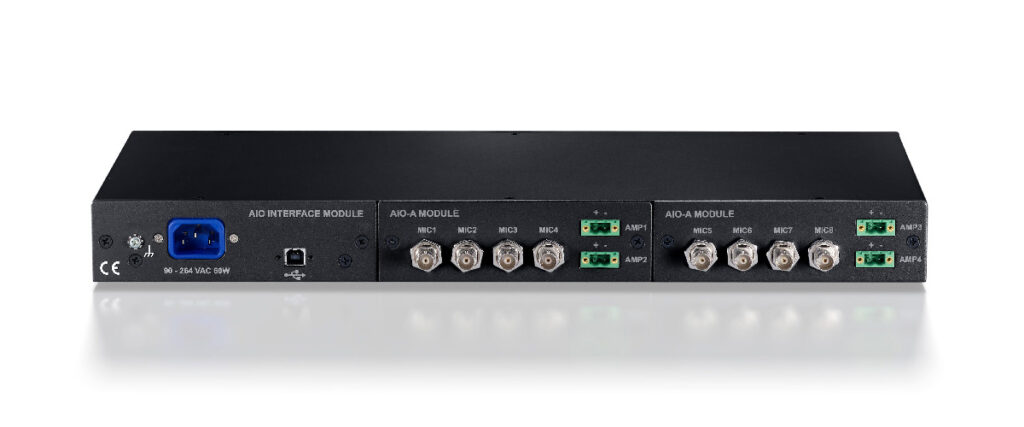
Test Modules
The AIO system supports various test modules for different applications. There are three module slots as shown above. The leftmost slot will always contain an Interface Module with the power supply, USB port, and control processor. The center and outer slots can contain different combinations of the following module types. The outer slot can be empty but the center slot must always be populated.
A – Acoustic Module- Four mic/line inputs with CCP, TEDS
- Two 10 W class-D amplifier outputs
Ideal for comprehensive acoustic testing applications.
L – Line-level Module- Four mic/line inputs with CCP, TEDS
- Two balanced line-level outputs
Perfect for professional audio equipment testing.
S – Speaker Module- Two mic/line inputs with CCP, TEDS
- Two 10 W class-D amplifier outputs
- Built-in speaker impedance measurement
Specialized for speaker testing and characterization.
H – Headphone ModuleTwo mic/line inputs with CCP, TEDS; two headphone/earbud outputs with impedance measurement. Designed for headphone and earbud testing.
T – TDM ModuleDigital TDM interface supporting up to 10 channels with 24 or 32 bit samples. Enables digital audio interface testing.
Hardware Configurations
The Echo AIO Test System is available in different hardware configurations (models) depending on the module type and position installed in the chassis. The product name is based on the combination of installed modules (i.e.: AIO-SA has one AIO-S and one AIO-A module).

AIO’s Modular Interface
Common AIO Configurations
| Model… | Inner Module | Outer Module | Mic/Line Inputs | Line Outputs | HP Outputs | Amp Outputs | Impedance |
|---|---|---|---|---|---|---|---|
| AIO-A1 | AIO-A | – | 4 | – | – | 2 | – |
| AIO-A2 | AIO-A | AIO-A | 8 | – | – | 4 | – |
| AIO-AH | AIO-A | AIO-H | 6 | – | 2 | 2 | 1 |
| AIO-H1 | AIO-H | – | 2 | – | 2 | – | 1 |
| AIO-H2 | AIO-H | AIO-H | 4 | – | 4 | – | 2 |
| AIO-L1 | AIO-L | – | 4 | 2 | – | – | – |
| AIO-L2 | AIO-L | AIO-L | 8 | 4 | – | – | – |
| AIO-S1 | AIO-S | – | 2 | – | – | 2 | 1 |
| AIO-S2 | AIO-S | AIO-S | 4 | – | – | 4 | 2 |
| AIO-SA | AIO-S | AIO-A | 6 | – | – | 3 | 1 |
| AIO-SL | AIO-S | AIO-L | 6 | 2 | – | 2 | 1 |
Additional configurations are possible, as long as they follow these rules:
a. Any combination of two analog audio modules (A, H, L or S) may be ordered, with either module in the inner or outer slot.
b. Any analog audio module (A, H, L or S) may be ordered for the inner slot, along with a T module in the outer slot.
c. For a single-module unit, the analog modules (A, H, L, or S) may be placed in either slot.
Modules are not sold separately, except as part of an upgrade by an authorized dealer to convert a single-module chassis to a two-module chassis. Modules do not function as stand-alone devices. They must be installed in an AIO chassis to operate.